Marking the 1126th anniversary of the birth of Saint Nicodemus the Abbot of Cirò
To mark the 1126th anniversary of the birth of Saint Nicodemus the Abbot of Cirò — born on 12 May in the year 900 in ancient Psicron, today's Cirò, in the Portello district — the painter Giuseppe De Fine presents this exhibition in his honour.
The paintings are shown along the corso, between the house and church where the Saint was born and the B&B San Nicodemo, from 1 to 22 August 2026.

Described by critics as a «contemporary impressionist», Giuseppe De Fine was born in Cirò, a town of saints and scientists such as Saint Nicodemus the Abbot and Luigi Lilio.
A painter from Cirò, in the generous land of Calabria, he is known for his gift for capturing the essence of the Calabrian landscape and of Calabrian life through art. His paintings are marked by a strong bond with his native soil and often portray everyday scenes, rural and coastal landscapes, local traditions, the sea, the sky, the natural world. His work stands out for its vivid colour and for a technique that blends realism and impressionism, evoking a sense of nostalgia and respect for tradition.
Recurring themes include the Calabrian landscape — its mountains, hills, vineyards and the sea that surrounds the region — as well as farming life, markets, village feasts and family moments, alongside folklore, traditional dress and religious celebrations.
He has exhibited in local and national shows — including Florence and Livorno — and abroad, in London. He has taken part in numerous group and solo exhibitions, receiving awards for his contribution to contemporary Italian art and critical praise for his technical skill and the emotional depth of his work.
He pursues other interests too: botany and ethnobotany — he is a member of the Italian Botanical Society, with scientific publications on his discoveries of rare flora and fauna — as well as poetry and theatre, as a director and playwright.
Among his awards: the Premio Europa for literature in the «Città di Marigliano», the painting prize in Tenerife, the Fiorino d'Oro in Florence, the Conca d'Oro in Rome and the Pontremoli prize; an honorary doctorate honoris causa in literature and painting from the Accademia Italiana Gli Etruschi; the title of Academic Senator from the Accademia Internazionale Città di Roma; the Oscar for Peace from Pope John Paul II; the Culture Prize awarded by the town council in 1997; the Medal of Merit at the Alda Merini literature prize and the «Vittorio Sgarbi» painting prize.
Tap a painting to read its full entry: caption, technique and critical note.
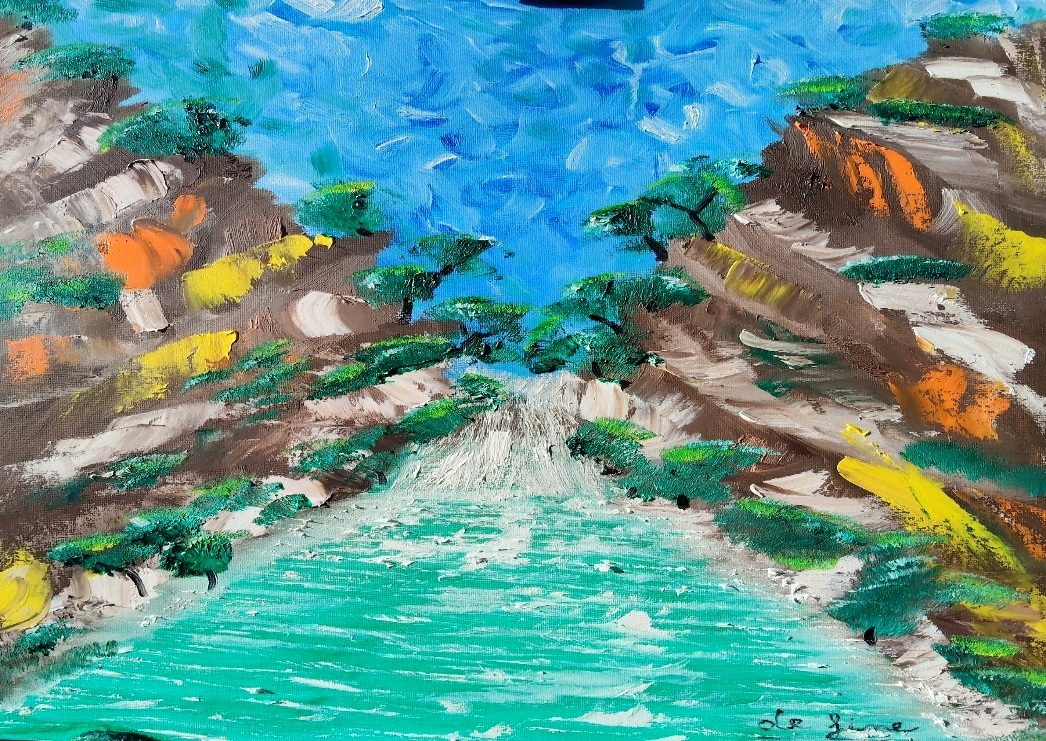
The painting shows a majestic natural landscape defined by a deep rocky gorge, through which runs a stream of crystalline turquoise water. Worked in oil on canvas, it is distinguished by a vigorous, energetic use of the palette knife, which lays the colour in thick layers and builds a rich relief of impasto.
The composition is dominated by the towering vertical walls of the canyon, where the tones of earth and rock are kindled by lively touches of yellow and orange standing for the reflections of sunlight. Patches of intense green mark out the vegetation clinging to the rock, while the perspective accelerates towards the centre of the canvas, drawing the viewer's eye along the water to the rock faces beyond. The sky, broken into dynamic strokes of blue and white, crowns the scene with a vibrant, characteristically impressionist atmosphere.
The energetic colour and the density of the paint recall certain currents of post-impressionism and expressionist landscape painting, where photographic accuracy gives way to the force of the gesture and to visual impact. It is a hymn to resilience: an invitation to pass through the narrow gorges of life with the fluidity of water, trusting that light and open space await us at the end of the way.
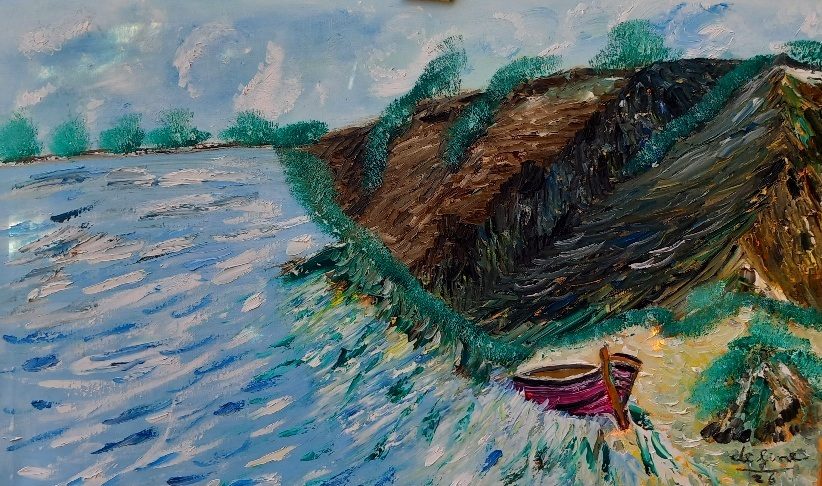
Within contemporary figurative painting, Giuseppe De Fine shows in this canvas a firm command of raking light and sharp chromatic contrast. The little magenta boat does not disappear but arrests the eye: the pale sand and the foam of the sea create at that point a kind of «natural spotlight» that makes the vessel stand out.
It is a work of considerable visual impact, joining the tradition of the Italian coastal landscape to a strong, modern expressiveness of colour, in which the small rowing boat — abandoned or moored on the sandy shore — becomes the very emblem of solitude. Yet this is not a sad or desolate solitude but a contemplative state: the boat stands for the human being who pauses to converse with the greatness of nature, cut off from the noise of the contemporary world — «alone», and at the same time the undisputed protagonist of the scene.
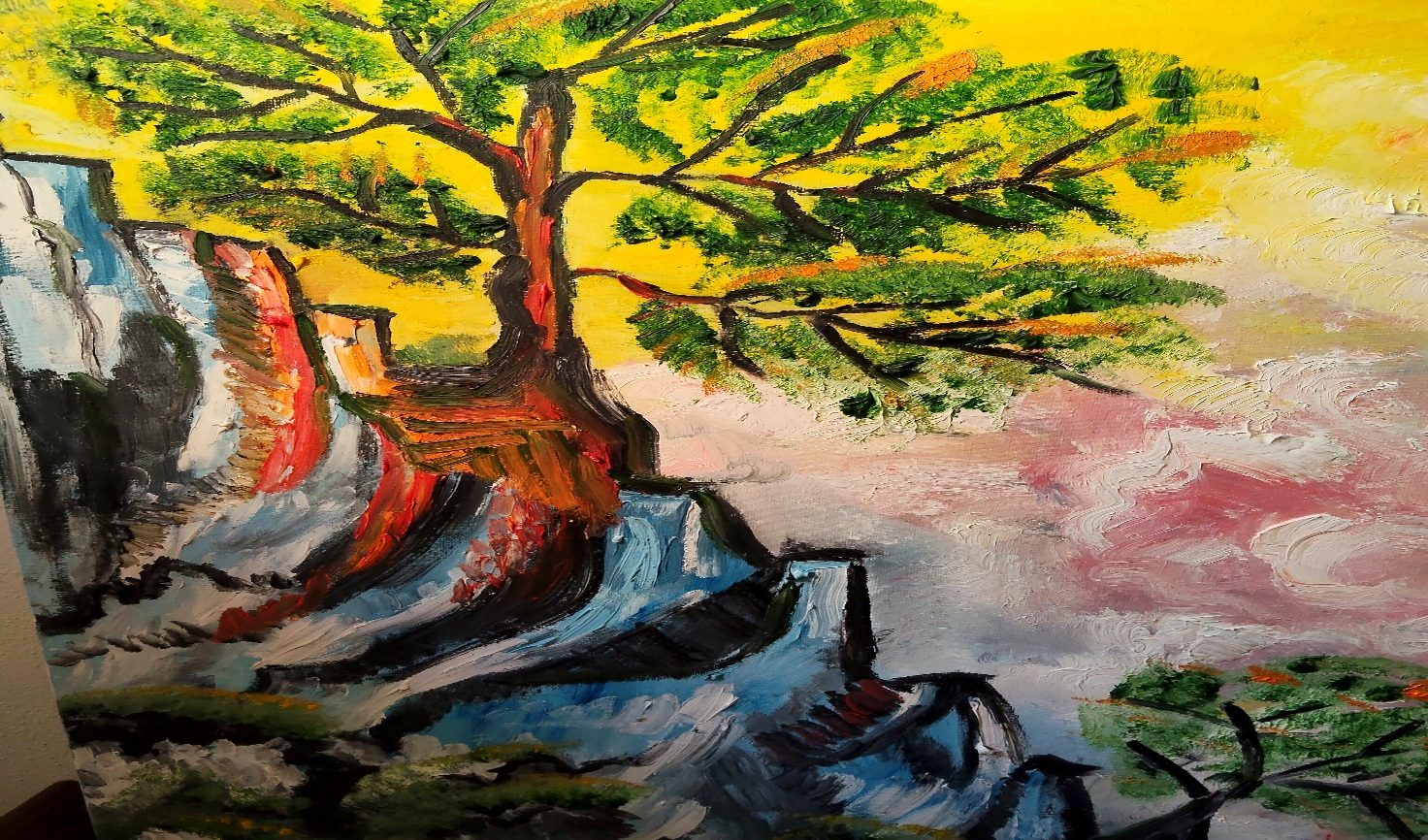
The painting stages both the struggle and the steadiness of nature. A solitary tree commands the precipice, anchored to the stone by visible, gnarled roots. Behind it lies a sea of rose-coloured mist that erases the ground below, heightening the sense of isolation and altitude.
The title, Roots, shifts the focus onto resilience. The tree becomes a metaphor for the human being, or for life itself: able to withstand storms, to stand firm in moments of emptiness (the mist) and to reach towards the light (the yellow sky) through its own inner strength and its own origins. The contrast expresses the paradox of existence: only those whose roots are strong and firmly set in the rock can reach out safely towards the infinite, towards the future and towards the freedom of the sky.
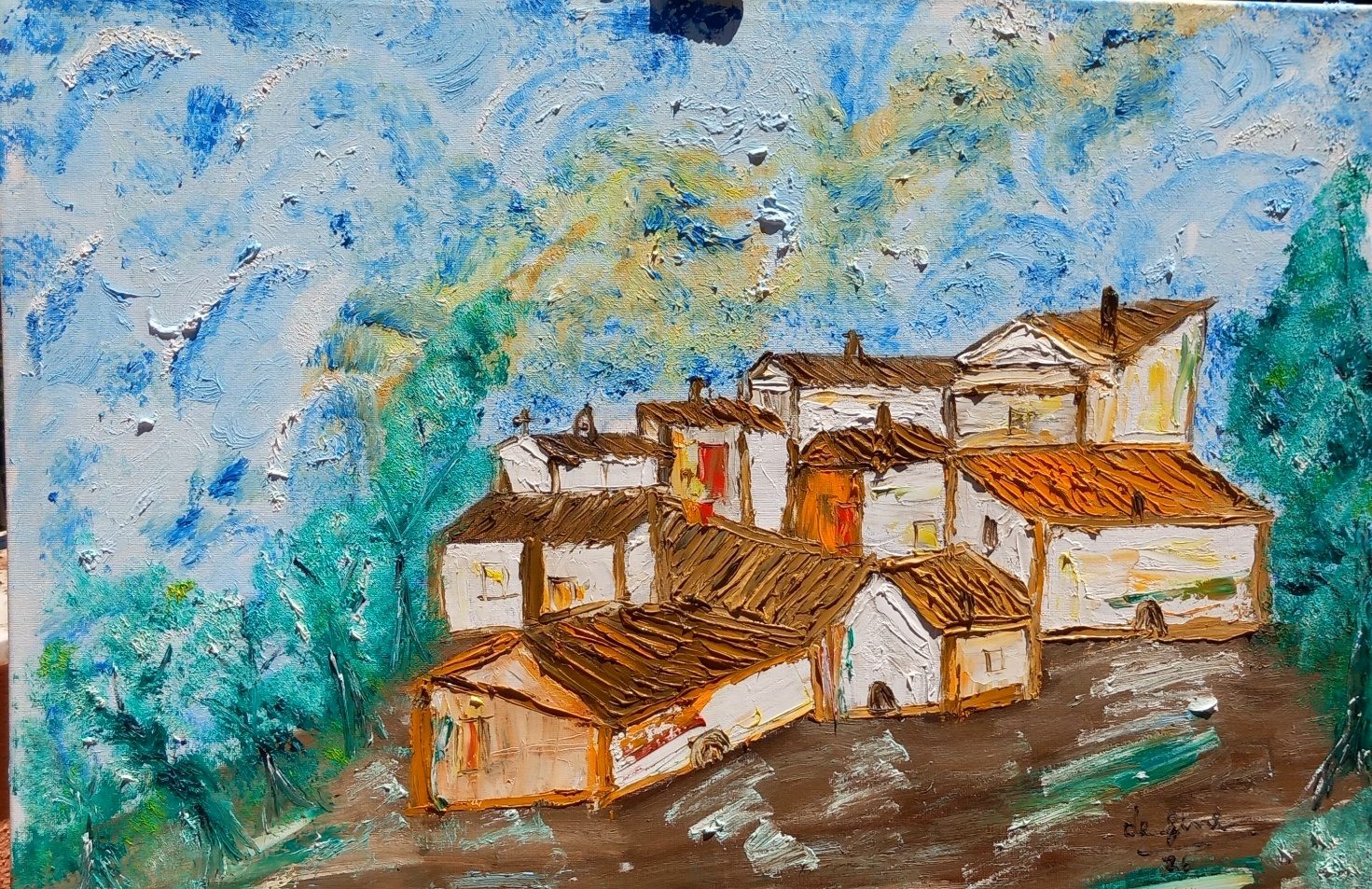
A vibrant work that captures the true soul of the Calabrian landscape. Through rich, dense, layered brushwork — characteristic of De Fine's search for texture — the painting brings out the play of volumes among the houses of an old village. The framing closes in on the architecture of the «ruga», the traditional alley, where the whiteness of the walls contrasts sharply with the vegetation and with a dramatic sky laid in swift, swirling touches.
Expressing a deep bond with his own roots, the artist turns this unplanned corner into a timeless tale, wrapping the landscape in an atmosphere charged with pathos, poetry and a powerful sense of identity.
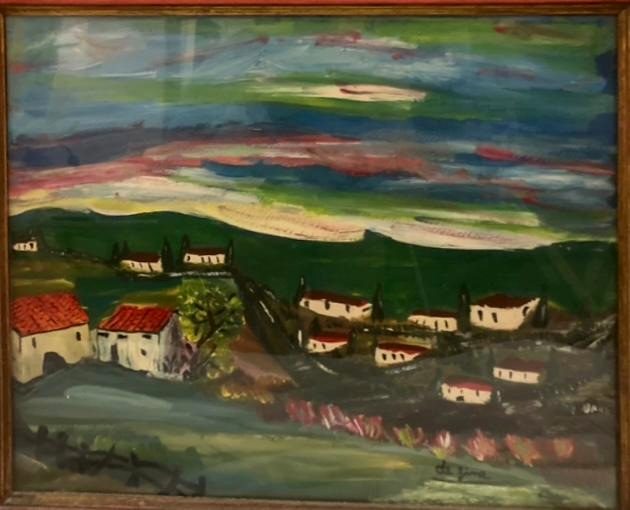
This composition offers an intimate, personal view of the Italian countryside, filtered through a naïve sensibility and a brilliant use of colour. The small white houses, with their deep red roofs, are set out in frontal perspective along the undulations of the land, while the cypresses, drawn in spare, repeated strokes, mark the visual rhythm.
The sky takes up much of the surface, condensing into a series of horizontal strokes an alternation of tones — from deep turquoise to soft pink, from acid green to cream — that suggests a moment of twilight. The absence of sharp shadows and the near-flatness of the forms reinforce the effect of a remembered image rather than an observation from life: the work becomes a «landscape of the soul», in which the emotion of colour prevails over realistic detail.
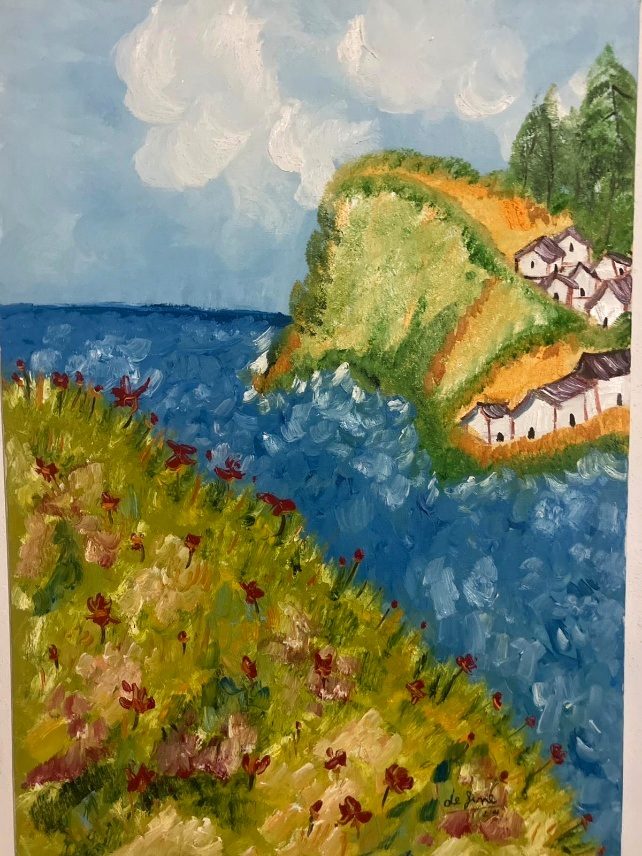
In «Beyond the Sea» the artist offers a contemplative view of the coast: a palette rich in greens, blues and bright reds creates a decisive chromatic impact that underlines the dialogue between land and water. The headland, almost monumental, stands out against a sea rippled by gestural strokes that give the scene its movement.
The flowering foreground introduces a note of warmth and intimacy, suggesting the call of a family past or of a time now lost. The sky, barely ruffled with white cloud, speaks instead of hope and of the promise of a journey «beyond» the horizon.
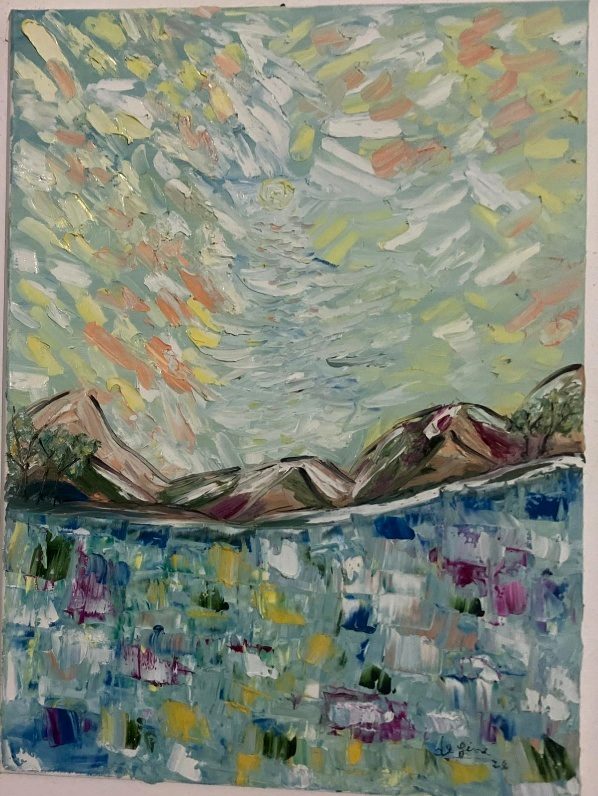
«A Watchful Eye» for Saint Nicodemus the Abbot of Cirò opens with a sky stirred by orbiting brushstrokes that range from cream to salmon, from pale yellow to soft sky-blue. These luminous vibrations seem to descend upon the stylised mountain chain, drawn in strong strokes and stippled with green and brown shadows. The mirroring lake, built up in blocks of colour, takes up the gestural signature of the sky and creates a circular visual rhythm.
The title points to a spiritual dimension: the artist symbolically asks for a protective gaze, a silent intercession that joins the sacred to the landscape. The style, close to an abstract and textural manner, testifies to a search for a language that speaks directly to the viewer's feeling.
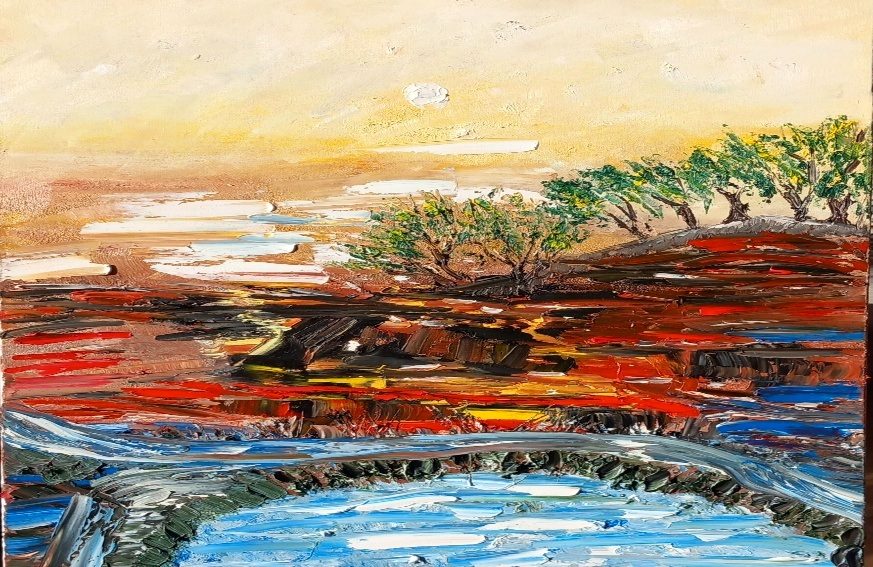
In «The Beyond», De Fine stages a visual and symbolic contrast between fluid elements and ground in turmoil. The foreground is dominated by a sheet of water painted in generous impasto of blue and white, with broad, soft strokes that suggest movement and coolness. Behind it, a succession of vigorous marks — vermilion red, intense black and touches of lemon yellow — sets out a burning soil, scored like open wounds in the earth itself.
The horizon line, raised and marked by an interlacing of green canopies, introduces an oasis of life and hope: the shrubs, rendered in finer and more textured strokes, seem to resist the harsh conditions below. The sky, painted in soft ochre and milky white, is punctuated by a solar disc accented with a stroke of the knife, a symbol of light become idea.
The composition does not follow a classical perspective: water and soil alternate in almost abstract planes, underlining the emotional character of the work. The emphatic use of colour and impasto creates a pulsing visual rhythm, in which the promise of a luminous «beyond» lives alongside the pain of a tormented present. The Beyond thus becomes an allegory of human experience: passing through inner conflict — the burning ground — to arrive at a rebirth that remains possible, represented by the soft green coming into leaf on the horizon.
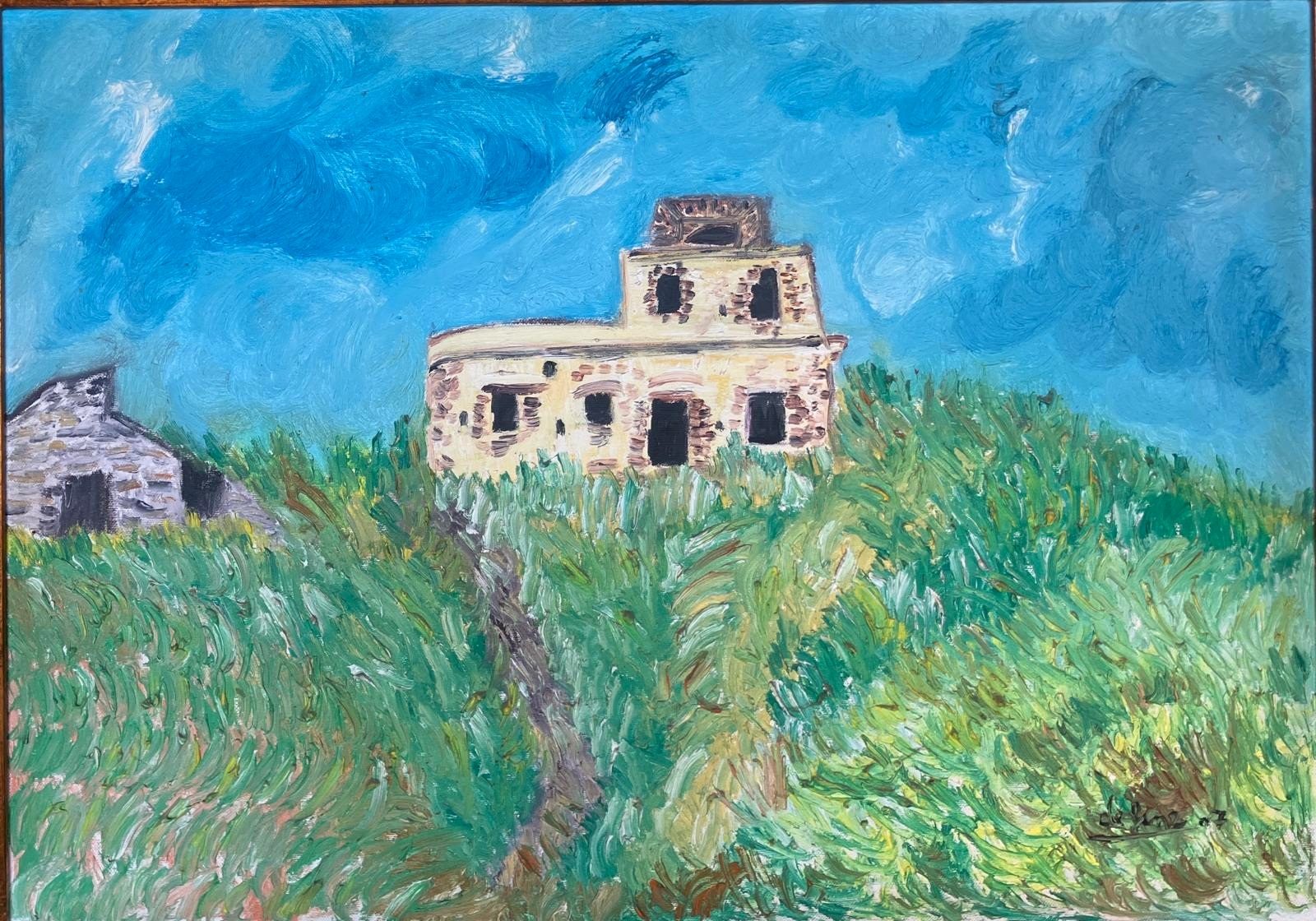
In «The Signal Station» De Fine offers a painterly rereading of a nineteenth-century coastal post, once used for optical communication between fortresses. The building, clearly defined by undulating strokes of ochre and brown, shows its solidity in thick walls and regular openings — functional elements turned into monumental form.
Behind it, a sky of intense turquoise is animated by swirls of brushwork that evoke salt air and sea wind; in the foreground the carpet of grass — tinted bright green with hints of yellow and white — underlines the untamed nature that surrounds the building. The emphatic impasto gives the surfaces relief: the grain of the walls and the texture of the grass take on a tactile thickness, while the clouds read like a wave about to break over the signal tower.
The absence of human figures heightens the sense of solitude and of military purpose, evoking the silence of the seasons in which the station was manned. The Signal Station thus becomes not only an architectural portrait but an allegory of the watchful gaze and of communication across distance: an invitation to reflect on historical memory and on the dialogue between people, military machinery and the natural world.
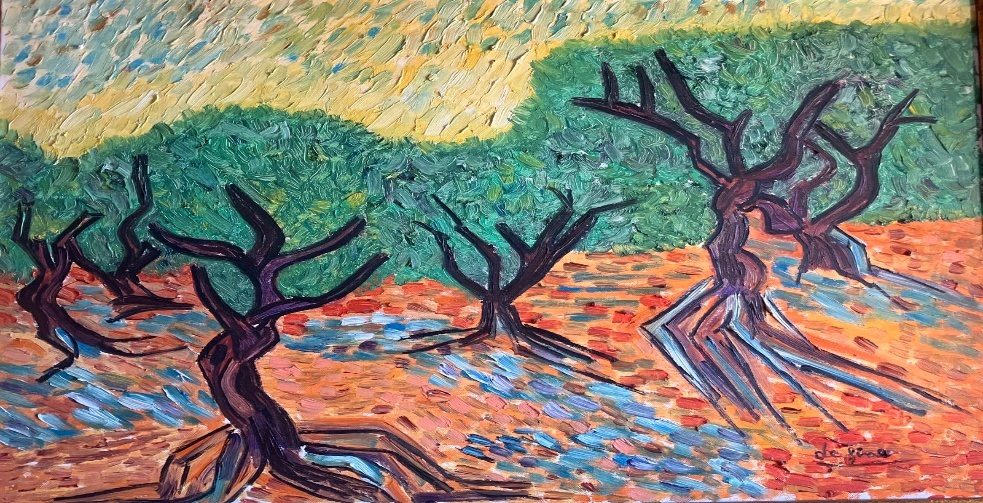
In «The Dance of the Olive Trees» De Fine organises the space in three horizontal bands: the foreground is a carpet of orange and blue marks suggesting the shade and light cast by the canopies; in the middle ground rise gnarled trunks, rendered in nervous strokes and thick impasto; at the back a wood of green foliage forms a compact backdrop, broken by a sky hatched in pale yellow.
The painter uses intense colours — earth orange, ultramarine blue, emerald green and solar ochre — to convey the energy of the Mediterranean landscape. The emphatic impasto lends three-dimensionality to roots and canopies, while touches of white light on the highest branches help to trace the swaying motion of the trees. The alternation of horizontal and vertical strokes creates a contrast of directions that reinforces the sense of «dance» and of wind passing through the scene.
The olive trees, emblems of longevity and resilience, become here dancers in an ancestral choreography: the twisted forms of the trunks evoke the suppleness with which nature withstands adversity, while the living ground and the luminous sky point to a continuous dialogue between earth and light. The work invites the viewer to see the landscape not as a static backdrop but as a vibrating organism, able to move and to restore us through its own motion.
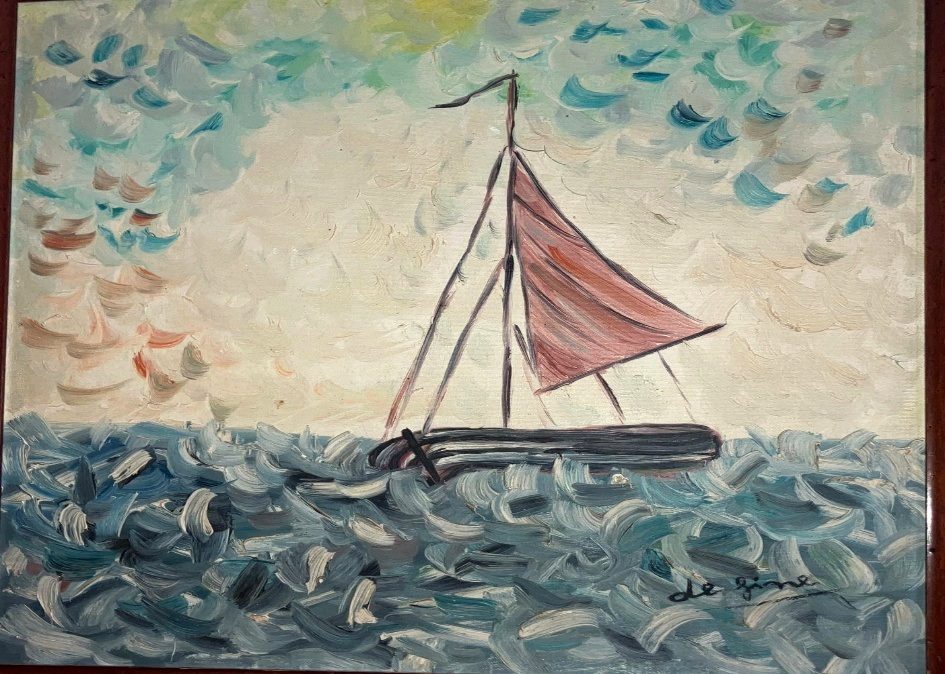
With «Voyage», dated 1999, De Fine explores the theme of the inner journey through the image of a sailing boat under way alone. The sea is animated by rapid, heavily textured strokes in which blues and greys alternate in a dance of waves that seem to set challenges to the small vessel. The sail, sketched in a warm rose-ochre, becomes the emblem of aspiration: it is the one note of living colour in a setting otherwise dominated by cool tones, underlining the strength of will needed to overcome uncertainty.
The sky takes up most of the canvas, with swarms of restless, vaporous strokes that speak of the wind driving the voyage. A lighter halo at the centre, laid in white and cream, suggests an apparent calm or, perhaps, a symbolic beacon to steer towards. The absence of any other landscape element or human figure heightens the sense of solitude and of personal challenge.
«Voyage» is not only a seascape but an allegory of the human condition: leaving the safe harbour behind to trust one's own sail and one's own inner impulse, accepting both risk and discovery. The textural technique and the choice of colour show a balance of dynamism and poetry, making the work an invitation to reflect on the value of every stage along the road of life.
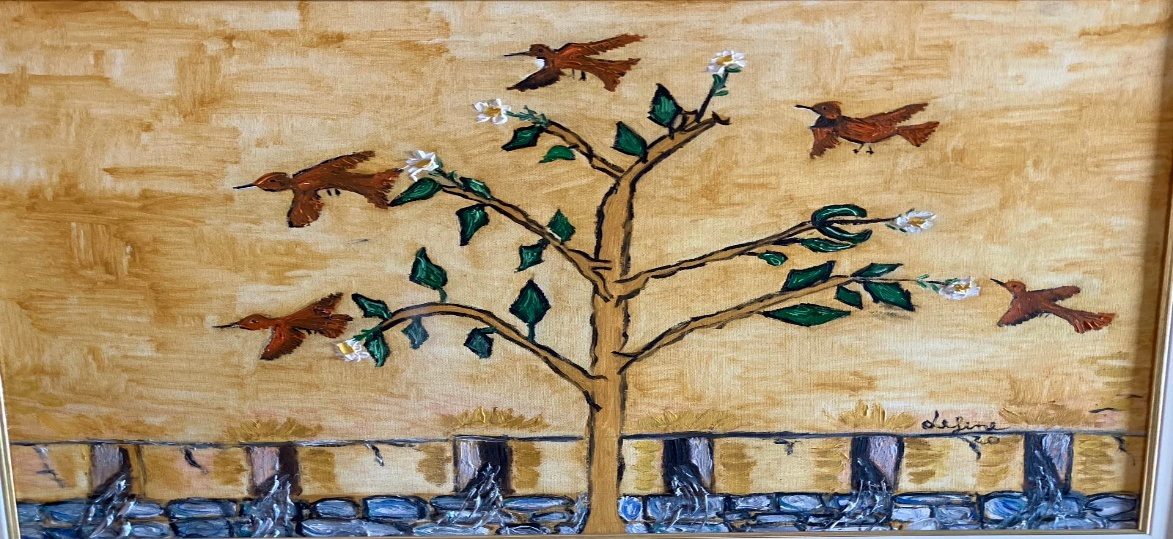
In «The Fountain of Life» De Fine brings natural and allegorical elements together in a single symbolic vision: the central trunk, painted with a naïve eye, branches into slender limbs bearing simple white flowers and dark green leaves defined by a dark outline. At its base a basin of pebbles opens into five jets of water — rendered in thick impasto and rapid strokes — which seem to feed the tree directly, underlining the theme of continual regeneration.
The use of a single ochre ground, worked in light horizontal strokes, gives the painting a suspended atmosphere: the warm tones counterpoint the deep greens and the inserts of white, creating a play of chromatic harmonies that speaks of the purity of water and of the sap of life. The small birds, painted in brown and orange, wheel about the branches like protective presences, evoking a sense of benevolent care.
While keeping to a simple and direct language, the artist experiments with the substance of the impasto — above all in the flow of the water — giving the textures both tactile and visual relief. The result is an allegory of hope and rebirth, in which the fountain becomes a symbol of perpetual life and of the interconnection of all natural things.
